


Nairobi, Kenya - June 30, 2026
bitcoin++ hosted its first Open Source Edition hackathon in Nairobi, Kenya, bringing together builders from Africa and around the world to work in public on practical Bitcoin software.
The hackathon ran during bitcoin++ Nairobi, the open-source edition, held June 17-19, 2026 at Pride Inn Azure Towers. The competition drew 90 participants, a record-breaking 37 submitted projects, and a prize pool of nearly 10 Million Satoshis across the main competition and sponsor tracks.
The event was supported by Bitcoin++, Soapbox, Btrust, and Minmo. Projects competed in the overall track, plus prizes for the best use of Soapbox, best contribution to open source, solving open-source contribution spam, best use of Pontmore, and the best tool for mobile-money brokers or agents using Bitcoin.
The judging panel included niftynei of Base58, Jodom of Minmo, Alex Gleason of Soapbox, Fabian Jahr of Brink, Sy of Btrust, Judy Imasuen of HRF, Kelvin Isievwore of Btrust, Michael of Cashu, Mark Kamau of Designing Africa, and Hadi Alamdar and Marvin Charles of Block.
Projects largely focused on mobile money and M-PESA, remittances, open-source developer education and support, maintainer tooling, and practical Bitcoin interfaces like Nostr relays, Lightning invoices, PSBTs, feature phones, and local merchants.


Projects
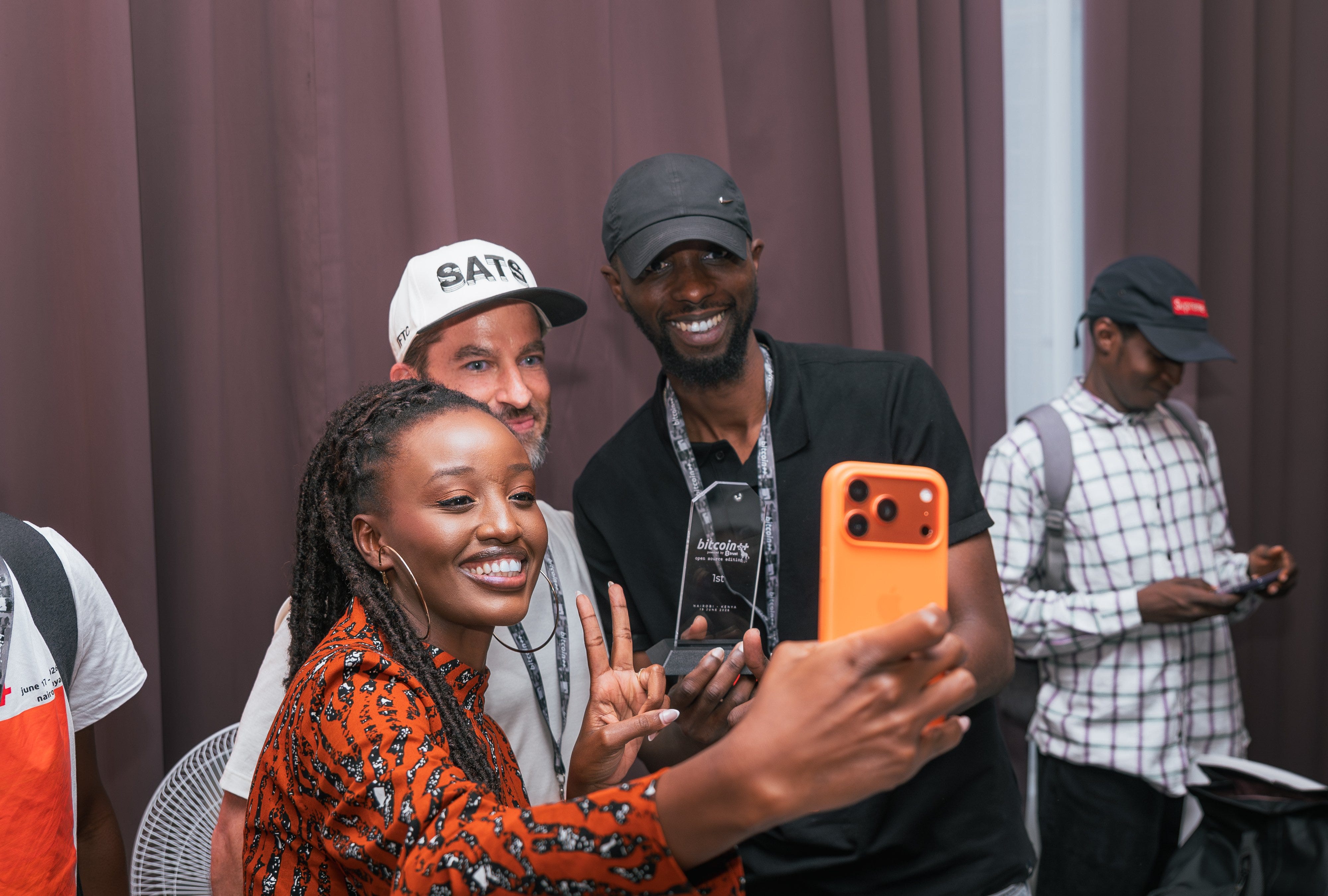
WestToEast, built by Nourou of Banxaas, won 1st Overall. The project connects West African mobile-money systems to Kenya’s M-PESA using Lightning, LNURL, Banxaas, and Tando. It lets a sender using XOF, XAF, or GNF through local mobile-money wallets in Senegal, Ivory Coast, Cameroon, or Guinea send value to a recipient receiving KES through M-PESA in Kenya.
The system uses Tando’s LNURL flow as the Kenya-side payout rail. Banxaas quotes the user in their local currency, receives the West African mobile-money payment, sends sats over Lightning to Tando, and Tando completes the M-PESA payout. According to the team’s submission, a Kenyan recipient can receive KES from three currencies and ten mobile-money wallets in less than 30 seconds.
Robin, built by Fidel Otieno of Bitika and Chris Oketch, won 2nd Overall. Robin is a context-aware guide for prospective Bitcoin open-source contributors. It asks who you are, what you know, and what you want to work on, then recommends where you can make a useful contribution.
The important idea is honest redirection. A new contributor does not always need to be pointed at Bitcoin Core. Sometimes the right answer is: not Core, not yet. Robin directs people toward work they can actually help with, while still giving stronger contributors specific routes into higher-context projects.
“Everyone else is building bouncers. We built a tour guide,” the Robin team wrote.
nairobi2, submitted by Anon Ym (GitHub), won 3rd Overall. The project is a permissionless ridesharing app with market-based price discovery and Sybil protection through verifiable Bitcoin notarization. The inspiration came from a local complaint many Nairobi riders and drivers understand immediately: platform taxis take large cuts and fix prices.
Built with Rust, Slint, Nostr, and Lightning, nairobi2 sketched an open alternative where drivers and riders coordinate directly and reputation can be anchored through Bitcoin-linked proofs rather than a closed platform.
Hodlr, built by Paul Eke, won Best Beginner Hack and an Honorable Mention. Hodlr lets users lock Bitcoin until a chosen date using the idea of CLTV-enforced savings. The project was framed around a lived problem: in weak local-currency environments, Bitcoin often becomes an emergency fund before it can become long-term savings.
Dishi Fresh, built by Thomas Cadra and Colly Sindani, won Best use of Soapbox. The project connects local recipes to nearby grocers, butchers, shops, and riders, with an M-PESA STK push flow and SMS notifications to vendors. It was one of the clearest examples of the week: useful local commerce first, Bitcoin-adjacent tooling second.
UTXOracle BTC Calculator, built by Parrish (Devpost: kingddd6767), won Best Contribution to Open Source. The project calculates a BTC/USD price from a user’s own Bitcoin node using UTXOracle instead of exchange APIs. The team also submitted a pull request to integrate UTXOracle into nix-bitcoin.
The open-source contribution spam track produced two direct maintainer tools. Filter, built by John Osezele, a Btrust grantee working on Bitcoin Dev Kit and Rust Payjoin, won the track. Filter is a configurable GitHub App that scores pull requests for spam likelihood using explicit rules around contributor reputation, PR description quality, diff patterns, AI-writing signals, and repo-specific checks.
Core-Gate, built by Aishaomaa Farah and Mary Wangui, attacked the same problem from the Bitcoin Core side. It runs as a fast GitHub Actions workflow before expensive CI, scores each incoming pull request against contribution guidelines and review-risk signals, then routes it into “needs work,” “needs attention,” or “ready for review.”
Together, Filter and Core-Gate showed that the AI-spam problem does not need to be treated as an argument about AI in the abstract. Maintainers need concrete triage tools, contributor routing, overrides, and explainable checks that reduce review waste without punishing sincere new contributors.
Pontswap, built by Wesley Nyamu and Cynthia Muemi, won Best use of Pontmore. Pontswap implements a Nostr-native coordination layer for Bitcoin-fiat swaps. Every public state transition is a signed Nostr event; private payment instructions are sent through NIP-59 Gift Wrap; and the full swap state chain can be replayed in a public explorer without exposing payment details.
LNpesa, built by Denver Mtange, Kelly Gakii, and Kendi Litala, won Best Tool for Mobile Money Brokers or Agents using Bitcoin. LNpesa is a USSD interface for Bitcoin agents built on the Pontmore open protocol over Nostr. An agent can dial a code, register from a feature phone, set liquidity, and publish signed Pontmore events to Nostr relays.
“No smartphone. No app. No internet data,” the LNpesa team wrote.
The project matters because it treats the interface as the adoption problem. In Kenya and across the continent, mobile money already works on feature phones. LNpesa brings Bitcoin agent workflows to that same surface instead of assuming every user will install a smartphone wallet first.
Tando’s Ark, built by Shamsudeen Adedokun of Tando and Matthew Vuk of Second, received an Honorable Mention. The project swapped Tando’s Lightning node infrastructure for Bark, Second’s implementation of Ark, while leaving the application layer and M-PESA payout flow intact.
For Tando, that means a path away from channel management and inbound-liquidity overhead. Existing Lightning users can still pay a unified invoice, while Ark-native users on the same Ark server can pay with arkoor transfers at 0% routing fees.
“The network effect is the product,” the Tando’s Ark team wrote.
Other Honorable Mentions included SiriScore, built by Susan Githaiga, Nkatha Kaburu, Rose Jane, and Nelly Nakhero, which scores Bitcoin transactions for privacy risks before they are signed or broadcast; Zaptip, built by Rita Anene, which adds a Lightning zap button to GitHub profiles and repos; MindfulSats, built by Tony Nakamoto, which uses Bitcoin-backed accountability for personal goals; and PoWR, built by Shannon Kioko, Lucy Kamau, Anne Mahonga, and Salma Adam, with support from the Dada Devs community.
PoWR turns GitHub contribution history into a proof-of-work-style reputation profile. The project also reflects the same maintainer problem that shaped several other submissions: not all commits are equal, and open-source ecosystems need better ways to recognize meaningful work.
Conclusions
The hackathon’s strongest through-line was pragmatism. Builders were not waiting for perfect abstractions or perfectly finished protocols. They used the tools already available: LNURL, Tando, Bark, Nostr, Pontmore, GitHub Actions, PSBTs, UTXOracle, USSD, M-PESA, and open-source AI tools. The result was rough in places, as hackathon work always is, but the direction was clear.
Bitcoin++ Nairobi showed that open-source Bitcoin work in Africa is not theoretical. It is mobile-money settlement, GitHub maintainer tooling, feature-phone UX, local commerce, contributor onboarding, transaction privacy, and protocol implementations that other teams can build on.
“The bitcoin++ week has proven once again that magic happens when people gather in one place,” said Sharon Murugi, Communications Lead at Btrust.
What began as a conference
hackathon became a practical map of where Bitcoin open-source development is going: more local, more interoperable, more aware of maintainer bottlenecks, and more focused on getting working software into the hands of people who can use it.