


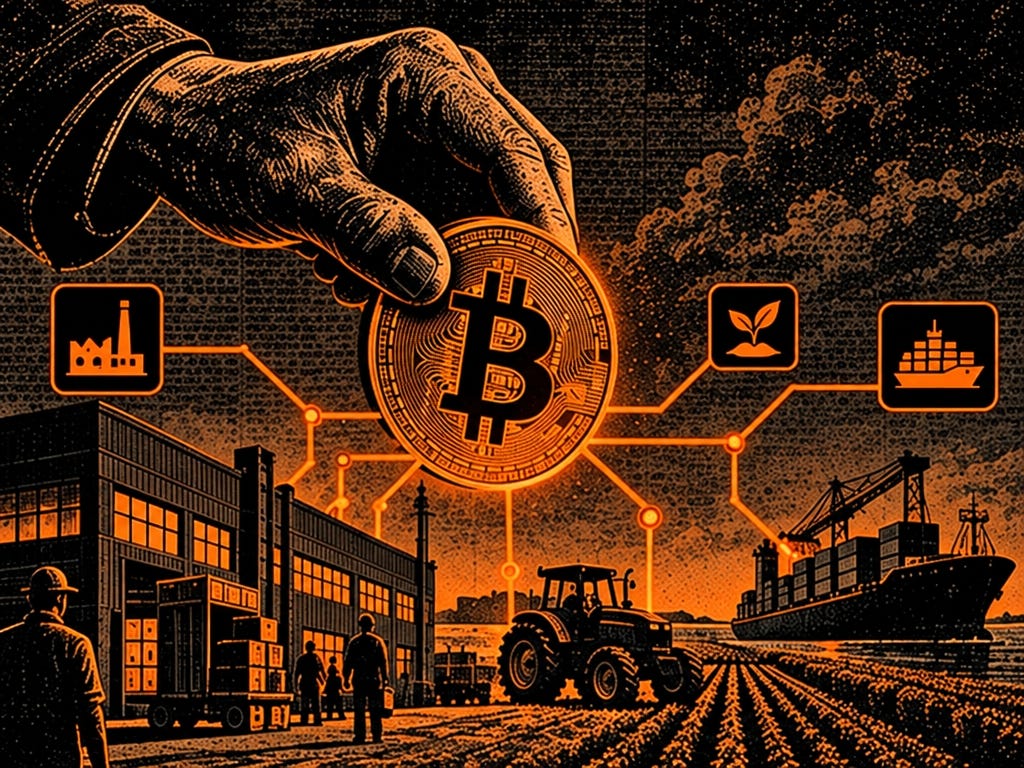
How do we make Bitcoin money for the Real Economy — the one concerned with the production, purchase, and flow of goods and services?
That is the fundamental question that Hubertus Hofkirchner is trying to answer. While he thinks that Bitcoin itself — with its famous 21 million coin limit — is perfect as a base money layer (or M0 as economists call it), he argues that it lacks the elastic credit money layer (M1) on top, which is required to become a functioning monetary system.
According to Hubertus, one of the major issues holding Bitcoin back from getting wide adoption in the real economy is its high volatility — i.e. sharp changes in money’s purchasing power. He states that in a modern, capitalist economy the currency needs to maintain a stable purchasing power to function properly, especially in the short-term (low volatility) and in the long-term (no inflation).
Bitcoin is safe from inflation but not from volatility. A sharp rise in the demand for Bitcoin leads to a strong rise in its exchange rate. The same is true the other way round: a sell-off can cause a price crash. Thus, making Bitcoin a currency to be used in a real market economy, depends on reducing its volatility. Bitcredit is expected to fix it as a welcome side-effect.
Besides volatility, Hubertus says there is one most fundamental problem that Bitcoin, the base money, cannot solve by itself: a manufacturer needs raw materials today to produce goods he will sell in the future. Where, on a Bitcoin standard, is the mechanism for this manufacturer to get advanced credit for supplies and to pay workers?
The market’s answer to both these problems has been to create a credit money layer on top of the base money layer. The credit layer creates the liquidity needed when goods are sold into the supply chain until the buyer resells the goods and redeems the credit. As Hubertus tells it, a healthy credit layer provides elasticity to a fixed base money, such that it can dampen sharp changes in the demand for money, and allows goods to always move, irrespective of the availability of external funding
Nowadays, trade credit is obtained from the banking system at the price of extensive applications, excessive regulatory restrictions, and intrusive Know-Your-Customer (KYC) requirements. All of this paperwork means that banks often have a minimum size requirement for loans, as the fixed cost of increased compliance efforts makes it too expensive to originate small and medium-size funding.
In the Global South the situation is even worse. Business loans and lines of credit are difficult to obtain. This barrier to entry in the credit market is basically insurmountable for most producers and commodity traders. Economists call this the trade finance gap: the difference between the demand for business financing compared to the actual amount of credit provided by financial institutions.
Of course, as any Bitcoiner knows, the trade finance gap is not the only problem. Credit through the fiat system comes with a caveat: inflation. Any time someone obtains a loan, new money is created out of thin air, which increases the total number of dollars in the economy. A larger money supply erodes the purchasing power and savings of other currency holders.
How can we reduce Bitcoin’s volatility, improve the finance trade gap, while avoiding minting more money backed by nothing?
Hubertus found his answer in a financial tool that was widely used in the past centuries, but that was displaced — and technically obsolete — by the advent of modern central banking: The Bill of Exchange (BoE).
The BoE is a business-to-business (B2B) type of credit, which historically filled the need of credit extension from one supply-chain business to the next. But what is it? A Bill of Exchange is defined as a written note which directs one business to pay a specified amount to another business, either on demand or on a defined future date. The BoE records a real transaction value, the price of goods is a result of a negotiation and agreement between a buyer and a seller. In many ways, this is similar to how modern invoices work, except the buyer issues the Bill of Exchange to the merchant.
While legacy bank credit requires an intermediary for the issuance of cash, BoEs work in a peer to peer fashion. Any business can issue a BoE to one of its suppliers with the promise to pay at a certain date in the future (e.g. 60 days).
Importantly, the value of the BoE is determined solely by the real, existing goods involved in the transaction. Rather than adding new fiat to the currency system, a BoE creates liquidity for produced goods. BoEs are backed by the value of exchanged goods, which are used for production and not consumption or speculation. Their existence is temporary. As soon as a BoE matures — reaches the payment date agreed upon by the parties — it is destroyed, leaving no inflationary consequences.
Historically, a BoE was supported by the reputation, credit history, and honesty of the person issuing it. A reputable buyer, a well-established business, or highly-regarded merchant could issue BoEs to their suppliers, leveraging their customers’ demand, their market position, and their trustworthiness to obtain credit for their business from their sellers. While legal means were in place to get remediation, the best incentive not to default on one’s obligation was the fear of being ostracized from the business community and the loss of credibility.
BoEs historically were used as wholesale money. The supplier receiving the BoE could, in turn, use it to pay their own supplier. They would add their own endorsement to the BoE, promising payment in case the original issuer defaulted. BoEs were able to be exchanged until they reached their maturity date, wherein the original issuer was required to pay stated value to the current holder of the BoE. Each forwarding of the BoE carried an explicit endorsement by the previous owner of the bill, effectively creating a chain of staked reputations, guaranteeing its payment.
BoEs could also be exchanged at a commercial bank in exchange for paper banknotes, similar to how depositing gold worked. Those paper notes, though, could be redeemed before the BoE maturity date — before the original BoE issuer had paid — which sometimes resulted in bank runs. As is required by regulations, the banks tended to fractionalize their holdings, issuing more paper bills than the face value of gold and BoEs they held, by also discounting a limitless supply of government bonds, war bonds and lombard, creating money against security collateral. Fractionalized banking wasn’t something only reserved for gold backed accounts.
Here’s a question though. Are businesses printing money by issuing Bill of Exchanges to their creditors? Is this something they are legally entitled to do so?
The simple answer is: Yes, and yes!
A more complex answer would be that, as we previously said, BoEs allow businesses to temporarily issue new ‘money’, whose value is bound to real goods and is destroyed as soon as the goods are sold and the debt is paid.
The legality of this action is way more interesting, however. Contrary to what they may want you to believe, central banks are not the only entity that can modify the amount of money in circulation. Businesses can issue BoEs, and they are legally allowed to do so. In fact, the 1930 Geneva Uniform Law — a set of standardized rules whose goal was to simplify international trade — formalizes the right of a business to issue BoEs.
Thanks to a convention from the United Nations Commission on International Trade Law (UNCITRAL) from 2017, that right also extends to electronic Bills of Exchange. The convention enables “the legal use of electronic transferable records both domestically and across borders” — with transferable records meaning “paper-based documents or instruments that entitle the holder to claim the performance of the obligation indicated therein and that allow the transfer of the claim to that performance by transferring possession of the document or instrument.” In plain English, this means that electronic contracts are to be treated legally exactly as their physical counterpart. Bills of Exchange are legal, whether written on paper or electronically issued.
Hubertus founded Bitcredit to bring Bills of Exchange into the digital realm. To do so, Bitcredit is built on open protocols from the modern cryptocurrency movement: Bitcoin, Nostr, and Chaumian ecash; the Bitcredit protocol itself is open-source. How does a modern e-BoE work?
Here’s how a typical Bitcredit e-BoE issuance and redemption flow would work:
Company A issues an electronic BoE (eBill) to their supplier, Company B. In exchange, Company A receives the supplies necessary to finish their product and bring it to market.
The supplier, Company B, can then endorse the eBill at a Bitcredit mint, called a Wildcat. The mint issues Chaumian ecash, whose value is backed by the eBill. eCash can then be used as retail money by Company B to pay for other goods, services, wages, and so on.
When the eBill reaches its maturity, Company A pays the Wildcat mint the face value in Bitcoin, and the eBill is destroyed. Any holder of the eBill’s ecash can now redeem them 1:1 for bitcoin with the Wildcat mint.
Another way to look at the Bitcredit protocol is through the pieces it is composed of: eBills and their statechains; Wildcat mints, the ecash layer; and an Identity and Transport Layer, via Nostr. Let’s take a look at each of these independently.
eBills
eBills are the foundational credit instrument of the Bitcredit protocol. At the economic level, they are 100% identical to paper Bills of Exchange. eBills are issued through the Bitcredit eBill application. The issuing company must undergo a verification and credit-worthiness check with its counterparty — i.e. the other business. Unlike the usual KYC procedures external banks impose, the eBill verification process only involves the two counter-parties, as any business would do when making a financial commitment with another.
Once the eBill has been signed (“accepted”) by the buyer, the supplying company delivers the requested products. The eBill can now be used as wholesale money: the recipient of the eBill, the supplier, can either endorse the eBill and use it to pay his own supplier network, or he can request a Wildcat mint to transform it into eCash.
The eBill comes with its own statechain. An eBill statechain records chain of ownership and string of endorsements, and is stored and transported over the Nostr protocol. This statechain ensures immutable, non-refutable ownership history. It’s stored on Nostr relays so that it is publicly available, but is encrypted so that only participants in the chain can actually see its contents.
An eBill has its own keypair. When the eBill needs to be redeemed, its public key is used together with the current holder’s public key — plus a tweak — to derive an onchain Bitcoin address. Only the payee knows both secrets, and thus is the only one eligible to claim the Bitcoin sent to that address.
Wildcat Mints
The Bitcredit team developed a new ecash implementation for their protocol. While it is based on David Chaum’s ecash and based on the same cryptographic ‘blinding’ primitives as the DigiCash, Cyperbucks, GNU Taler, Cashu and Fedimint protocols — blind signatures (BDHKE) — Bitcredit eCash represents the real commercial credit of eBills, besides outright Bitcoin.
The role of the mints, called Wildcats, is to turn eBills into exchangeable ecash proofs. An eBill holder would endorse it to the Wildcat mint; in exchange they would receive eCash. eCash is in essence a divisible, privacy preserving form of the endorsed eBill, functioning as retail money for everyday users.
Once the eBill reaches maturity, the mint receives the Bitcoin payment. The funds go directly to a taproot output that can only be spent by a script leaf requiring a FROST threshold signature from a signatory set — a subset of Wildcat mints called a Clowder. Technically, a mint operator alone never controls the keys and cannot steal funds.
eCash holders request a melt quote to the mint, burn proofs, and supply a Bitcoin address to receive the payout.
The Bitcredit protocol requires that a Wildcat mint must be overcollateralized, to protect from eBills that are not paid or credited on schedule. To accomplish this, the Wildcat mints lock funds into a digital asset called $e-IOU’s, visible and verifiable on-chain. This on-chain channel includes a remedy transaction. The $e-IOU’s remedy transaction is claimable in the case that a Wildcat mint fails to honor the eBill at expiry. $e-IOUs are sold for Bitcoin sp that ecash remains fully backed.
$e-IOUs are also used in case an eBill issuer fails to pay the eBill at maturity. The mint sells the $e-IOU’s for Bitcoinsand pursues legal recourse off-chain against one of the prior parties who endorsed the eBill to get reimbursed.
What is an $e-IOU, though? As of today, an $e-IOU is a token based on the BRC-20 standard (more information can be found on Uniscan) as a transitional, working choice. The team is currently working to migrate to the RGB protocol.
The Wildcat mint has a statechain as well, which records its eBill holdings and their statuses. The statechain can be queried real-time by eCash wallets to verify the health of a mint. The statechain records the total value of a Wildcat mint’s eBills holdings, the status of each of those bills, the total amount of eCash minted, and the mint’s current $e-IOU holdings.
Identity and Transport Layer through Nostr
The Nostr protocol is used both as an identity layer and as a transport mechanism.
A company who wishes to participate in the eBill system needs an identity. To do this, Bitcredit uses the Nostr protocol’s public key system. Each company would hold a private key nsec and corresponding public key npub. Those keys are the company’s persistent identity in the Bitcredit protocol and stays the same trades and eBills.
Through repeated usage, the company’s public key, or npub, earns reputation, called credit history. By tracking companies through successful trade after trade, Bitcredit can recreate the mechanism of checks and balances that made BoEs widely used instruments in prior eras. The company’s private key, or nsec, is known only to the company and permissioned parties. They use it to originate and endorse eBills, or interact with Wildcat mints.
Nostr is used also as the transport layer to move eBills between participants in the network — a sort of “post office” as Hubertus puts it. eBills are exchanged through NIP-17-based Nostr DMs, and then gift-wrapped using NIP-59.
Bitcredit also developed its own custom Nostr relay, bcr-relay , tailored to the protocol’s needs.
Towards a Money for the Real-World Economy
Bitcredit is already being put under test in the real world, with the first transactions already underway in the Global South. The first live transaction, Bitcredit’s “Pizza Day” was an export bag of specialty coffee sold by Cherito Coffee in El Salvador to Sound Imports in the U.S.A. and minted on 16 September 2026. By extending peer-to-peer credit simply and securely, Bitcredit is freeing these businesses from the dependency on external bank credit, making the owners’ visions come to reality with higher efficiency, sales and profitability.
Will Bitcredit manage to bring the classic Bill of Exchange back to the modern economy? If so, they’ll manage to close one of the most important gaps preventing Bitcoin from becoming everyday money: credit. Closing the trade finance gap could really bootstrap Bitcoin as the Medium of Exchange many hope it will become for the global economy.